Certified Ethical Hacking Associate (CEHA) | Cybersecurity Exam.
CEHA – Certified Ethical Hacking Associate
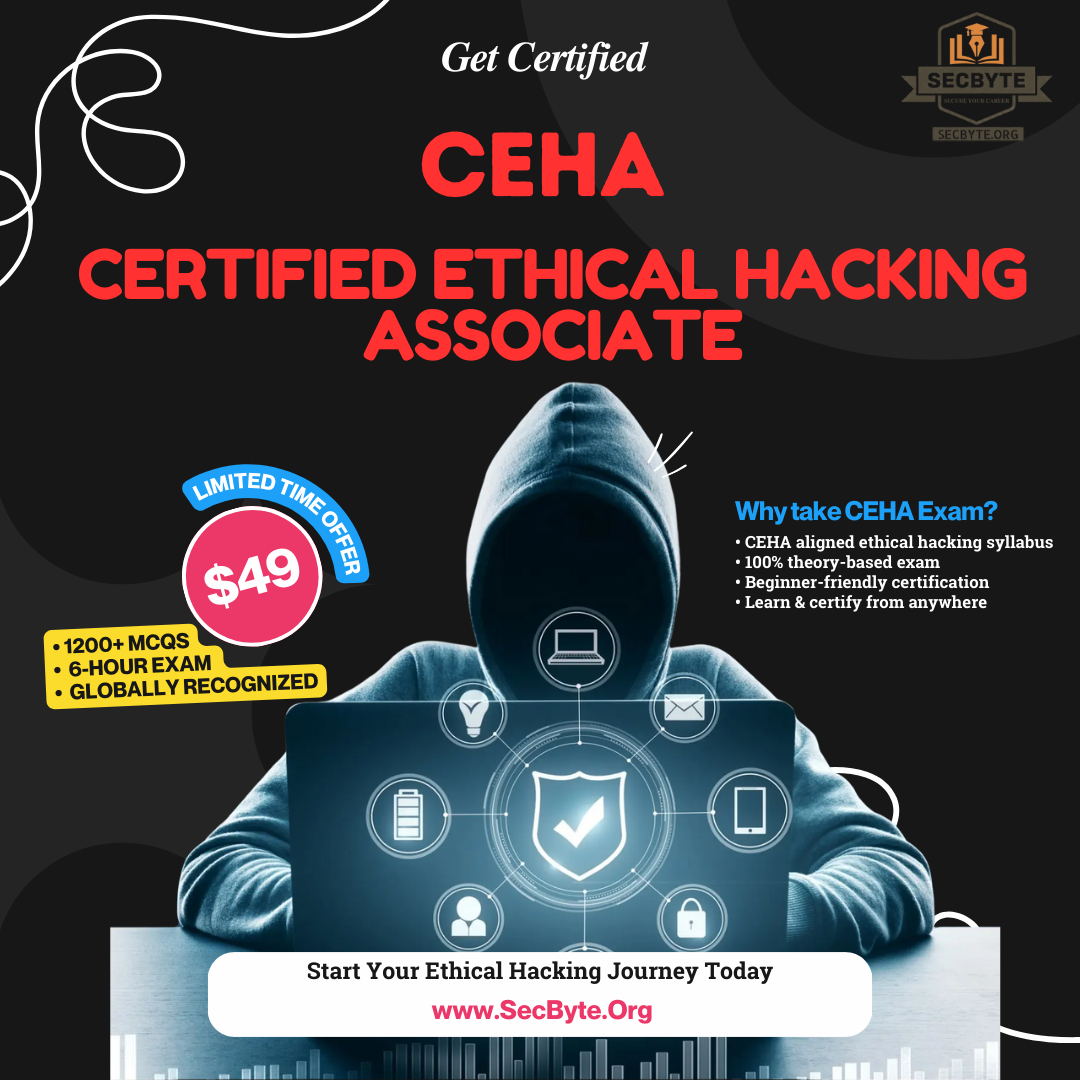
The Certified Ethical Hacking Associate (CEHA) is a comprehensive, theory-based cybersecurity certification designed to validate foundational and intermediate knowledge of ethical hacking concepts, tools, techniques, and defensive strategies.
This certification assesses a candidate’s understanding of real-world attack methodologies, system vulnerabilities, network security, and countermeasures through an extensive multiple-choice examination. CEHA is ideal for students, beginners, and professionals seeking structured validation of their ethical hacking knowledge.
Exam Highlights:
-
1500 multiple-choice questions
-
6-hour online examination
-
Globally aligned cybersecurity syllabus
-
Beginner to intermediate level
-
100% theory-based assessment
📚 CEHA SYLLABUS
(Aligned with modern ethical hacking standards — full coverage, CEH v13 level)
Module 1: Introduction to Ethical Hacking
-
Information security overview
-
Ethical hacking concepts
-
Cybersecurity laws and ethics
-
Types of hackers and attack vectors
Module 2: Footprinting and Reconnaissance
-
Passive and active reconnaissance
-
OSINT techniques
-
DNS, WHOIS, and social engineering reconnaissance
-
Competitive intelligence gathering
Module 3: Scanning Networks
-
Network scanning techniques
-
Port scanning and service enumeration
-
Firewall and IDS detection
-
Vulnerability scanning concepts
Module 4: Enumeration
-
User, group, and system enumeration
-
SNMP, LDAP, SMB enumeration
-
NetBIOS and service enumeration
Module 5: Vulnerability Analysis
-
Vulnerability assessment lifecycle
-
Vulnerability scanning tools and methods
-
CVE, CVSS, and risk scoring
-
Patch and configuration management
Module 6: System Hacking
-
Password cracking techniques
-
Privilege escalation
-
Maintaining access
-
Covering tracks
Module 7: Malware Threats
-
Types of malware
-
Trojans, viruses, worms, ransomware
-
Malware analysis fundamentals
-
Countermeasures and prevention
Module 8: Sniffing
-
Packet sniffing techniques
-
ARP poisoning and MITM attacks
-
Sniffing tools and detection methods
Module 9: Social Engineering
-
Psychological principles of social engineering
-
Phishing, vishing, and smishing
-
Social engineering attack vectors
-
Prevention techniques
Module 10: Denial-of-Service
-
DoS and DDoS concepts
-
Botnets and attack tools
-
Detection and mitigation techniques
Module 11: Session Hijacking
-
Session management vulnerabilities
-
Session hijacking techniques
-
Prevention and secure session handling
Module 12: Web Application Hacking
-
Web application architecture
-
OWASP Top vulnerabilities
-
SQL injection, XSS, CSRF
-
Secure coding principles
Module 13: Web Server Hacking
-
Web server architecture
-
Attacks against web servers
-
Web server hardening
Module 14: Wireless Network Hacking
-
Wireless standards and encryption
-
Wi-Fi attacks
-
Wireless security tools
-
Countermeasures
Module 15: Mobile Platform Security
-
Mobile OS security
-
Mobile malware and attacks
-
Mobile application vulnerabilities
Module 16: IoT and OT Hacking
-
IoT architecture and threats
-
OT and SCADA security
-
IoT attack vectors and defenses
Module 17: Cloud Computing Security
-
Cloud service models
-
Cloud security threats
-
Cloud hardening techniques
Module 18: Cryptography
-
Encryption algorithms
-
Hashing and digital signatures
-
PKI and key management
-
Cryptographic attacks
Module 19: Penetration Testing
-
Penetration testing methodologies
-
Planning and scoping
-
Reporting and documentation
Module 20: Security Operations and Incident Response
-
SOC concepts
-
Incident response lifecycle
-
Threat intelligence
-
Digital forensics basics
Module 21: AI, Machine Learning & Security
-
Role of AI and ML in cybersecurity
-
AI-powered attack techniques
-
Adversarial machine learning concepts
-
Defensive use of AI in threat detection
Module 22: Container & DevOps Security
-
Docker and container security concepts
-
Kubernetes security risks
-
CI/CD pipeline vulnerabilities
-
DevSecOps principles and best practices
Module 23: Zero Trust Architecture
-
Zero Trust security model
-
Identity-centric security
-
Network segmentation
-
Zero Trust implementation challenges
Module 24: Digital Forensics Fundamentals
-
Digital forensics process
-
Evidence acquisition and preservation
-
Disk, memory, and log analysis concepts
-
Legal and ethical considerations
Module 25: Governance, Risk & Compliance (GRC)
-
Information security governance
-
Risk assessment methodologies
-
Security policies and standards
-
Compliance frameworks and audits
📝 CEHA Exam Procedure
-
Online, theory-based certification examination
-
Total 1500 multiple-choice questions (MCQs)
-
6-hour exam duration
-
Covers complete ethical hacking and cybersecurity syllabus
-
Exam navigation may be restricted once 80% of the allotted time has elapsed
-
Candidates are advised to manage time efficiently before the restriction phase
-
Automatic evaluation after final submission
-
Results processed as per certification guidelines
-
-
- Official Certification
- Any
- CEHA SYLLABUS
- 1 Section
- 0 Lessons
- Lifetime
- Certified Ethical Hacking Associate (CEHA) Exam1
You might be interested in
-
All levels
-
56 Students
-
0 Lessons
-
All levels
-
56 Students
-
0 Lessons
-
All levels
-
51 Students
-
0 Lessons
-
All levels
-
51 Students
-
0 Lessons
-
All levels
-
60 Students
-
0 Lessons
-
All levels
-
60 Students
-
0 Lessons
-
All levels
-
56 Students
-
0 Lessons
-
All levels
-
56 Students
-
0 Lessons
Sign up to receive our latest updates
Get in touch
Call us directly?
Visit Us
Need some help?
Partners List
- © 2026 SecByte.org rights reserved.