
Professional Diploma in Ethical Hacking & Penetration Testing
Offered by SecByte.org
The Professional Diploma in Ethical Hacking & Penetration Testing by SecByte.org is a comprehensive, industry-aligned cybersecurity program designed to develop highly skilled, ethical, and job-ready security professionals.
In a world where cyber threats are growing in scale, complexity, and impact, organizations across the globe are actively seeking trained professionals who can identify vulnerabilities, defend digital assets, and perform lawful security testing. This diploma was created to meet that demand by combining technical depth, hands-on practice, and professional discipline into one structured learning pathway.
At SecByte, our mission is not just to teach tools or techniques — we shape responsible cybersecurity professionals who understand the legal, ethical, and operational realities of modern information security.
Whether you are a beginner with no prior hacking experience, a career switcher entering cybersecurity, or an IT professional seeking specialization, this diploma offers a flexible, affordable, and internationally relevant pathway into ethical hacking and penetration testing.
A Program Built for the Real World
This diploma is structured using open educational resources released under the MIT Open License, combined with professional cybersecurity training frameworks. This ensures learners benefit from globally recognized open-learning standards, modern curriculum design, and legally compliant academic resources.
The program follows an open credit learning system, allowing students to progress at their own pace. Learners who complete all academic and practical requirements early may graduate before the standard 12-month duration.
Why Choose SecByte?
✅ Learn from World-Class Universities & Programs
The curriculum integrates globally respected academic and professional learning models, drawing from open-education frameworks widely used in international higher education and cybersecurity training.
✅ 12 Months Flexible Learning (Open Credit System)
Study at your own pace with the freedom to accelerate your learning. Highly motivated students can finish early and receive certification sooner.
✅ 460+ Hours of Hands-On Practical Training
Gain real-world experience through:
-
Practical labs
-
Attack and defense simulations
-
Industry-standard tools
-
Realistic cybersecurity scenarios and case studies
✅ USA, UK & EU Academic Recognition
The diploma is structured under internationally accepted academic and institutional accreditation frameworks, making it suitable for global academic and professional recognition.
✅ High Job Placement Potential
The program is designed around current industry skill requirements, making graduates competitive for entry-level to intermediate cybersecurity roles.
✅ Top Internship Access
Eligible students may gain access to internship opportunities to strengthen practical experience and professional exposure.
✅ Career Support Services
Students receive guidance in:
-
Professional cybersecurity reporting
-
Resume and portfolio preparation
-
Interview readiness
-
Career pathway planning
Program Overview
-
Program Duration: Up to 12 Months (Flexible)
-
Learning Mode: Online / Distance Learning
-
Certification Awarded: Professional Diploma Certificate
-
Early Completion: Allowed under open credit model
-
Program Fee: USD 299
-
Scholarships: Up to 90% available for eligible students
This program is designed to be globally accessible, affordable, and suitable for students from diverse educational and professional backgrounds.
Student Benefits After Enrollment
All enrolled students receive:
🎓 Official 2-Year Student ID Card
📧 Institutional Student Email Address (secbyte.org)
📚 Full access to course materials, labs, and assessments
📄 Enrollment verification and academic confirmation
These benefits help students maintain a verified academic identity during and after their studies.
What You Will Learn
This diploma delivers in-depth training across core and advanced cybersecurity domains, including:
-
Ethical Hacking Principles & Legal Frameworks
-
Penetration Testing Methodologies
-
Network, Web, Cloud, and Wireless Security Testing
-
Cybersecurity Fundamentals & Defensive Strategies
-
Cryptography & Secure Network Communication
-
Information Security Governance & Risk Management
-
Vulnerability Assessment & Controlled Exploitation
-
Incident Analysis & Professional Reporting
-
Advanced Penetration Testing Concepts and Techniques
Graduates are trained to think like attackers, act responsibly, and communicate findings professionally to technical teams and non-technical stakeholders.
Career Outcomes
Graduates of the Professional Diploma in Ethical Hacking & Penetration Testing may pursue roles such as:
-
Ethical Hacker
-
Penetration Tester
-
Cybersecurity Analyst
-
SOC (Security Operations Center) Analyst
-
Security Operations Assistant
-
Red Team Support Specialist
The diploma also provides a strong academic and technical foundation for advanced cybersecurity certifications and further studies.
Eligibility Criteria
To ensure academic readiness and ethical responsibility, applicants must meet the following minimum criteria:
-
✅ Minimum Age: 18 years
-
✅ Educational Requirement:
-
High School completed OR
-
College / University student or graduate
-
-
✅ Basic computer knowledge recommended
-
❌ No prior hacking experience required
This program is beginner-friendly while still advancing learners to professional-level competencies.
Admission Requirements
Applicants are required to submit:
-
Valid government-issued identification (for verification)
-
Proof of education (High School or College completion)
-
Completed enrollment application
-
Agreement to ethical conduct, legal compliance, and academic honesty policies
While we provide career support, internship access, and professional guidance, job placement depends on individual performance, skills, and market conditions.
Ethical Commitment
SecByte is firmly committed to promoting legal, ethical, and responsible cybersecurity practices.
All students must agree to:
-
Follow international cyber laws and regulations
-
Use skills strictly for ethical and authorized purposes
-
Uphold professional integrity and academic honesty
Ethical responsibility is a core pillar of this diploma.
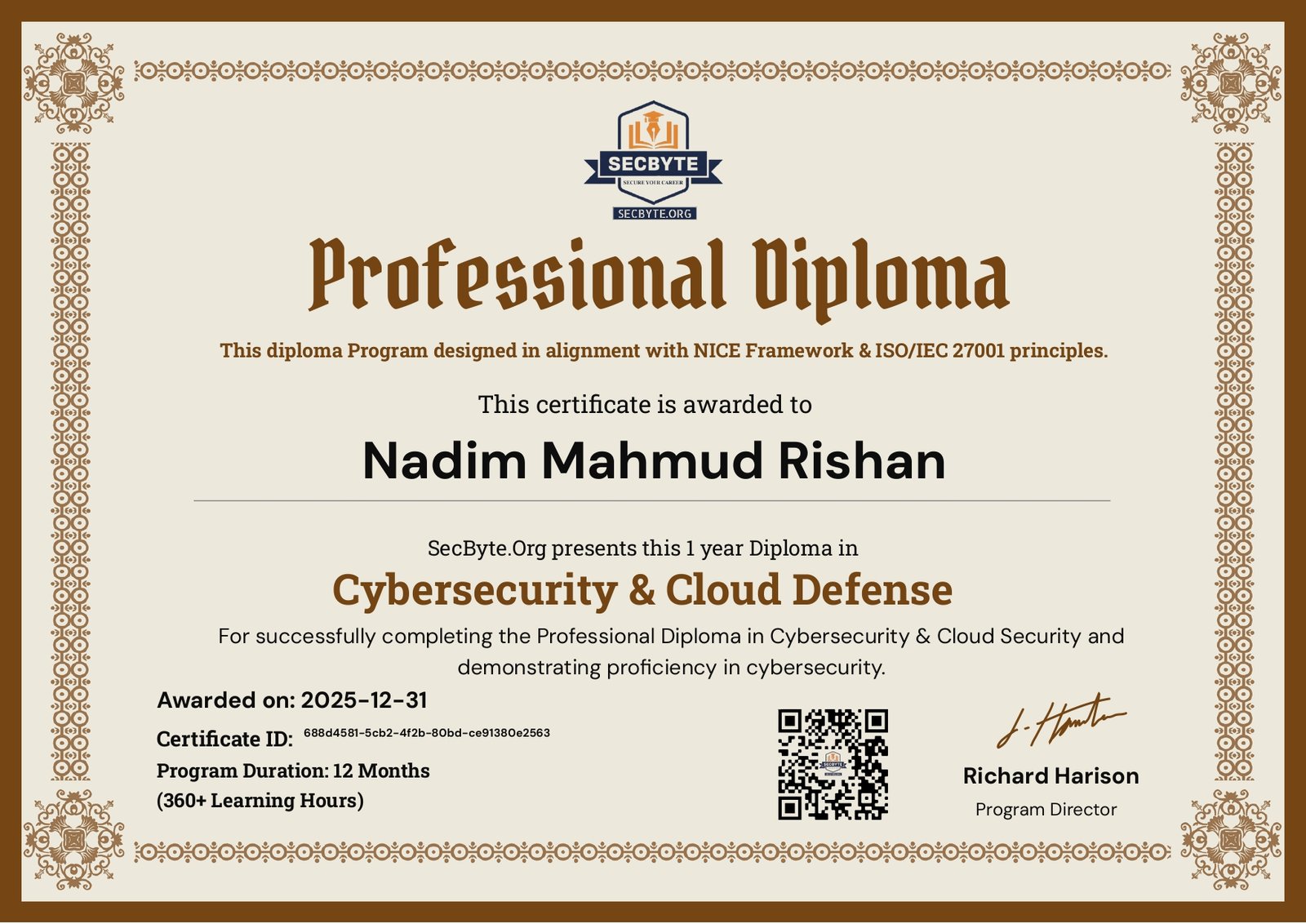
Demo of Verified Certificate:
- 5 Sections
- 150 Lessons
- 52 Weeks
- ESL002 – Intermediate English as a Second Language30
- 1.1Foundations of Professional English
- 1.2Grammar Structures for Technical Communication
- 1.3Vocabulary Building for IT Professionals
- 1.4Understanding Cybersecurity Terminology
- 1.5Sentence Precision & Clarity
- 1.6Formal vs Informal Communication
- 1.7Reading Technical Manuals & Documentation
- 1.8Email Writing for IT Environments
- 1.9Workplace Communication Skills
- 1.10Listening Skills for Technical Discussions
- 1.11Paragraph Writing Techniques
- 1.12Pronunciation for Global Professionals
- 1.13Descriptive & Explanatory Writing
- 1.14Writing Instructions & Procedures
- 1.15Interpreting Charts & Technical Data
- 1.16Presentation Skills for Beginners
- 1.17Note-Taking & Summarization Techniques
- 1.18Error Identification & Correction
- 1.19Professional Conversation Practice
- 1.20Workplace Etiquette & Language
- 1.21Writing Short Technical Reports
- 1.22Understanding Security Policies Language
- 1.23Critical Reading Skills
- 1.24Language for Problem Solving
- 1.25Collaborative Communication
- 1.26Role-Play for IT Scenarios
- 1.27Confidence Building in English
- 1.28Review & Reinforcement Exercises
- 1.29Applied Technical English Practice
- 1.30Final Language Assessment
- ESL004 – Advanced English as a Second Language30
- 2.1Advanced Grammar Applications
- 2.2Advanced Cybersecurity Vocabulary
- 2.3Writing Incident Reports
- 2.4Interpreting Legal & Policy Documents
- 2.5Executive Summary Writing
- 2.6Risk & Compliance Language
- 2.7Precision Writing for Professionals
- 2.8Formal Business Correspondence
- 2.9Professional Presentation Mastery
- 2.10Argumentative & Analytical Writing
- 2.11Negotiation & Discussion Skills
- 2.12Writing Technical Proposals
- 2.13Client-Facing Communication
- 2.14Writing Security Policies
- 2.15Documentation Standards
- 2.16Proofreading & Editing Techniques
- 2.17Professional Meeting Communication
- 2.18Tone, Style & Audience Control
- 2.19Advanced Listening Comprehension
- 2.20Ethical & Legal Terminology
- 2.21Writing Audit Reports
- 2.22Cross-Cultural Communication
- 2.23Academic Writing Fundamentals
- 2.24Crisis Communication Skills
- 2.25Research Reading Techniques
- 2.26Public Speaking for Professionals
- 2.27Professional Writing Workshops
- 2.28Report Review & Improvement
- 2.29Final Proficiency Evaluation
- 2.30Applied Cybersecurity Writing
- CS50’s Introduction to Computer Science30
- 3.1How Computers Work
- 3.2Introduction to Computational Thinking
- 3.3Problem-Solving Methodologies
- 3.4Variables & Data Types
- 3.5Introduction to Programming Logic
- 3.6Loops & Conditions
- 3.7Control Structures
- 3.8Binary & Data Representation
- 3.9Functions & Modularity
- 3.10Arrays & Data Storage
- 3.11Algorithms Fundamentals
- 3.12Memory Concepts
- 3.13Sorting Algorithms
- 3.14Algorithm Efficiency
- 3.15Searching Algorithms
- 3.16Introduction to C Programming
- 3.17Debugging Techniques
- 3.18Command-Line Basics
- 3.19File Handling Concepts
- 3.20Introduction to Python
- 3.21Secure Coding Awareness
- 3.22Error Handling
- 3.23Software Development Lifecycle
- 3.24Testing & Validation
- 3.25Introduction to Databases
- 3.26Programming Best Practices
- 3.27Mini Programming Projects
- 3.28Capstone Programming Task
- 3.29Final Assessment
- 3.30Applied Problem Solving
- CS50’s Introduction to Cybersecurity30
- 4.1Cyber Threat Landscape
- 4.2Introduction to Cybersecurity
- 4.3Types of Cyber Attacks
- 4.4Malware Fundamentals
- 4.5Password Security
- 4.6Social Engineering Attacks
- 4.7Network Security Basics
- 4.8Authentication Systems
- 4.9Firewalls & IDS
- 4.10Data Protection
- 4.11Web Security Basics
- 4.12Secure Browsing
- 4.13Encryption Fundamentals
- 4.14Cloud Security Overview
- 4.15Mobile Security
- 4.16Incident Response Basics
- 4.17Digital Privacy
- 4.18Cyber Laws & Ethics
- 4.19Risk Management
- 4.20Threat Modeling
- 4.21Defensive Security Concepts
- 4.22Security Awareness Training
- 4.23Vulnerability Fundamentals
- 4.24Cybersecurity Tools Overview
- 4.25Security Monitoring
- 4.26Case Studies Analysis
- 4.27Cyber Defense Strategies
- 4.28Practical Security Scenarios
- 4.29Review & Application
- 4.30Final Cybersecurity Assessment
- CS260 – Introduction to Cryptography & Network Security30
- 5.1History of Cryptography
- 5.2Foundations of Cryptography
- 5.3Symmetric Encryption
- 5.4Asymmetric Encryption
- 5.5Hash Functions
- 5.6Authentication Mechanisms
- 5.7Digital Signatures
- 5.8Key Management
- 5.9Secure Communication
- 5.10Cryptographic Protocols
- 5.11Network Security Concepts
- 5.12TCP/IP Security
- 5.13Secure Network Design
- 5.14VPN Technologies
- 5.15Wireless Security
- 5.16Cryptographic Attacks
- 5.17SSL/TLS
- 5.18Network Threats
- 5.19Intrusion Detection
- 5.20Firewalls & Gateways
- 5.21Secure Email Systems
- 5.22Network Monitoring
- 5.23Cryptography Tools
- 5.24Practical Encryption Labs
- 5.25Network Defense Techniques
- 5.26Risk Analysis
- 5.27Case Study Review
- 5.28Applied Network Security
- 5.29Final Examination
- 5.30Review & Practice